SUMMARY
- A collision can damage suspension components even when the body damage appears relatively minor.
- Common suspension parts that may be affected include control arms, struts, shocks, steering knuckles, tie rods, ball joints, bushings, wheel hubs, and mounting points.
- Possible signs of suspension damage include vehicle pulling, an off-center steering wheel, uneven tire wear, vibration, clunking noises, unusual ride height, or a wheel that appears out of position.
- Suspension damage can also affect wheel alignment and steering geometry, so an alignment alone may not solve the problem if a component is bent or damaged.
- A direct impact to a wheel, curb strike, side collision, or front-end crash can transfer force into suspension and steering components.
- Structural damage can also affect suspension geometry when collision forces move the areas where suspension components attach to the vehicle.
- Modern vehicles may require diagnostic scanning, steering-angle procedures, or ADAS calibration after certain suspension or alignment repairs, depending on the manufacturer.
- Drivers should not assume a vehicle is safe to continue driving if the steering, ride, or wheel position changes after a collision.
- Wenzl’s Collision Center provides collision repair, structural measuring, steering and suspension evaluation, wheel alignment, diagnostics, and calibration when required.
- Lincoln drivers can visit Wenzl’s Collision Center at 4515 N 62nd St, Lincoln, NE 68507, United States for professional collision damage assessment and repair.
Introduction
After an accident, most drivers focus first on the visible body damage.
Maybe the fender is dented.
The bumper is cracked.
A wheel has a scrape.
But collision forces do not always stop at the body panel you can see.
They can also affect the suspension and steering components behind the wheel.
That matters because the suspension helps control:
- Wheel position
- Vehicle stability
- Ride quality
- Steering response
- Tire contact with the road
A damaged suspension component can make the vehicle:
- Pull
- Vibrate
- Handle differently
- Wear tires unevenly
- Sit lower on one side
Sometimes the problem is obvious.
Other times the vehicle still drives, but something feels slightly wrong.
Professional collision repair should evaluate both the visible body damage and any mechanical or structural components that may have been affected.
What Does the Suspension System Do?
The suspension connects the vehicle body or structure to the wheels.
Its job includes helping:
- Maintain tire contact with the road
- Control vehicle movement
- Absorb road impacts
- Support steering geometry
- Maintain predictable handling
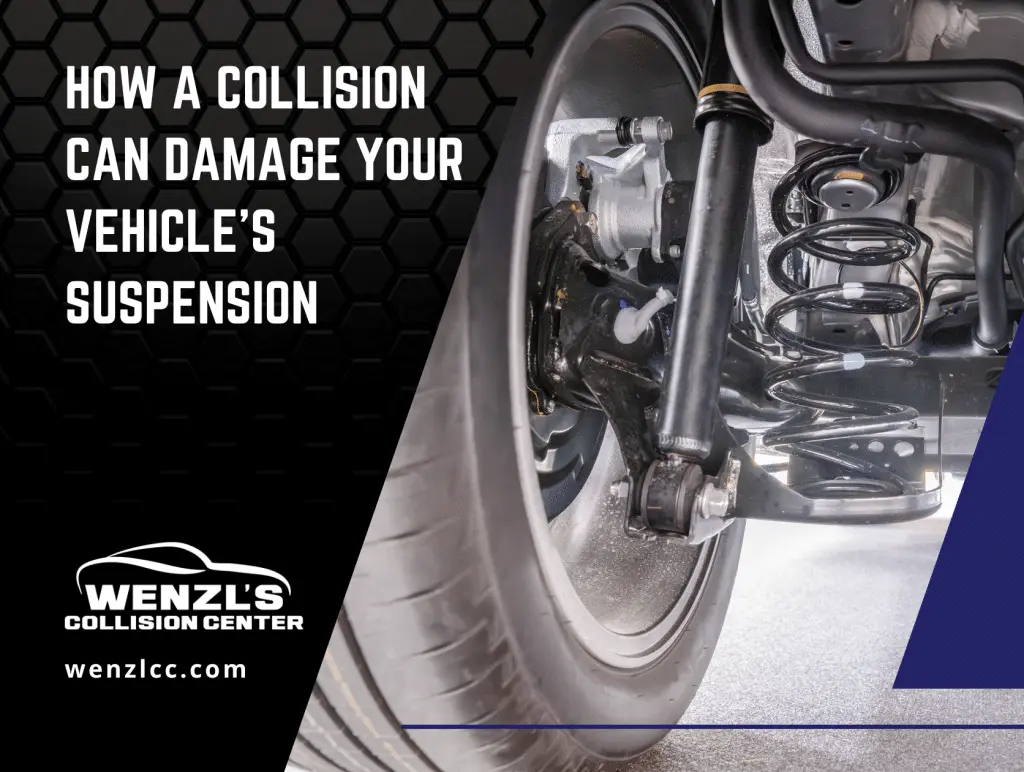
Depending on the vehicle, suspension components may include:
- Control arms
- Struts
- Shocks
- Springs
- Ball joints
- Steering knuckles
- Tie rods
- Bushings
- Wheel hubs
- Subframes
These components work together.
If one is bent or damaged during a collision, the effect can extend beyond that single part.
How Can a Collision Damage the Suspension?
Collision forces can reach the suspension in several ways.
A direct impact may involve:
- Wheel
- Tire
- Fender area
- Front corner
- Rear corner
The vehicle can also be pushed into:
- Curb
- Median
- Guardrail
- Another vehicle
Even if the first point of contact is the bumper or body panel, the collision force can travel through nearby components.
The actual damage depends on:
- Impact direction
- Impact severity
- Vehicle design
- Wheel position
- Suspension type
Can a Minor Collision Damage the Suspension?
Yes.
A collision does not need to be severe to affect suspension geometry.
For example, a relatively low-speed impact directly into a wheel can damage suspension more easily than a larger-looking scrape that affects only a door skin.
Possible damage can involve:
- Bent control arm
- Damaged tie rod
- Wheel or hub damage
- Alignment changes
- Mounting-point movement
That does not mean every small accident causes suspension damage.
The impact location matters.
Why Are Wheel Impacts Especially Important?
The wheel is directly connected to the suspension and steering system.
If another vehicle hits the wheel or the vehicle is forced into a curb, collision force can transfer into:
- Knuckle
- Tie rod
- Control arm
- Strut
- Hub
- Subframe
The wheel itself may also become:
- Bent
- Cracked
- Misaligned
That is why wheel-area impacts should be evaluated carefully even when the surrounding body damage looks limited.
What Are the Signs of Suspension Damage After a Collision?
Possible symptoms include:
- Vehicle pulling left or right
- Steering wheel off center
- New vibration
- Clunking
- Uneven ride height
- Wheel positioned differently
- Tire rubbing
- Uneven tire wear
- Vehicle feeling unstable
These signs do not automatically prove suspension damage.
For example, pulling can also result from:
- Tire pressure
- Alignment
- Tire damage
- Structural movement
Professional inspection is needed to identify the actual cause.
Why Does the Vehicle Pull After an Accident?
A vehicle may pull if collision damage changes the relationship between:
- Wheel
- Suspension
- Steering
- Structural mounting points
Possible causes include:
- Bent suspension component
- Alignment change
- Damaged tire
- Bent wheel
- Steering damage
- Structural movement
If the pulling began immediately after the accident, mention that to the repair facility.
The timing can help guide the inspection.
What Does an Off-Center Steering Wheel Mean?
If the steering wheel is suddenly crooked while the vehicle travels straight, something may have changed in:
- Wheel alignment
- Steering components
- Suspension geometry
A crooked steering wheel should not simply be repositioned without determining the underlying cause.
The problem may require:
- Suspension repair
- Steering repair
- Alignment
- Structural correction
Can a Collision Bend a Control Arm?
Yes.
Control arms help locate the wheel relative to the vehicle structure.
A direct impact can bend or damage them.
Possible symptoms include:
- Alignment changes
- Pulling
- Wheel position changes
- Tire wear
A bent control arm should be replaced or repaired according to the vehicle manufacturer’s procedures.
Simply adjusting alignment around a damaged component is not a complete repair.
Can Tie Rods Be Damaged?
Yes.
Tie rods connect the steering system to the wheels.
A wheel impact can potentially bend or damage them.
Symptoms can include:
- Steering wheel off-center
- Poor steering response
- Alignment problems
- Vehicle wandering
Because tie rods influence steering, collision-related damage should be addressed before normal driving resumes.
Can Struts or Shocks Be Damaged?
Yes.
A collision can affect:
- Strut body
- Shock absorber
- Mounting points
- Related suspension components
Visible fluid leakage or obvious deformation can indicate damage.
But not all problems are visually obvious.
A technician may need to inspect the component and compare vehicle geometry with specifications.
Can Ball Joints Be Damaged in a Collision?
Potentially.
Ball joints allow suspension movement while helping control wheel position.
A strong wheel-area impact can affect:
- Ball joint
- Control arm
- Knuckle
Damage may contribute to:
- Loose steering
- Noise
- Alignment problems
The complete corner of the suspension should be evaluated rather than replacing only the most visibly damaged part.
Can Steering Knuckles Bend?
Yes.
The steering knuckle connects several important components, which may include:
- Hub
- Wheel bearing
- Strut
- Control arm
- Tie rod
A collision can potentially bend or damage it.
Because the knuckle directly affects wheel geometry, even relatively small deformation can influence alignment.
Professional measurement is important.
Can Wheel Hubs and Bearings Be Damaged?
Yes.
A wheel impact can transfer force into the:
- Hub
- Bearing
- Axle
- Knuckle
Possible signs can include:
- Noise
- Vibration
- Wheel play
However, these symptoms can also have other causes.
The repair facility should inspect the complete assembly.
Can a Collision Damage Suspension Bushings?
Yes.
Bushings help isolate movement and vibration between suspension components and the vehicle structure.
A collision can:
- Tear
- Distort
- Displace
a bushing.
Damage may contribute to:
- Clunking
- Alignment changes
- Handling differences
Bushings should be evaluated along with the components they support.
Can a Subframe Be Damaged?
Yes.
Many vehicles use front or rear subframes that support:
- Suspension
- Steering
- Powertrain components
A collision can potentially move or damage the subframe itself.
This can affect:
- Wheel alignment
- Suspension geometry
- Steering position
The technician may need to inspect:
- Subframe
- Mounting points
- Structural attachment areas
before final alignment is performed.
Why Is a Subframe Different From the Vehicle Frame?
A subframe is a structural assembly attached to the main vehicle body or structure.
It may support:
- Engine
- Suspension
- Steering rack
Depending on the vehicle.
Damage to a subframe can create alignment or geometry problems even when the main unibody structure remains within specification.
That is another reason collision diagnosis should identify exactly which component moved.
Can Suspension Damage Affect Tire Wear?
Yes.
If wheel angles change because of suspension damage, tires can wear unevenly.
Patterns can include:
- Inside-edge wear
- Outside-edge wear
- Feathering
- Irregular tread wear
The amount and speed of wear depend on how far the geometry is out of specification.
Driving for too long with the problem can shorten tire life significantly.
Why Is Alignment Important After Suspension Damage?
Alignment measures wheel angles such as:
- Toe
- Camber
- Caster
When suspension components are repaired or replaced, the alignment should be evaluated if required.
However, alignment should usually come after damaged parts are identified and corrected.
Adjusting the wheels while a component remains bent can produce misleading or unstable results.
Can an Alignment Alone Fix Collision Damage?
Not always.
An alignment machine can adjust certain wheel angles within the vehicle’s design.
But it cannot repair:
- Bent control arm
- Damaged tie rod
- Bent knuckle
- Damaged subframe
- Structural movement
If a component is physically damaged, the underlying problem needs to be repaired first.
What Does Toe Mean?
Toe describes whether the wheels point slightly inward or outward when viewed from above.
If toe is outside specification, the vehicle may experience:
- Tire wear
- Poor tracking
- Steering instability
Collision damage to tie rods, control arms, or mounting points can affect toe.
What Is Camber?
Camber is the inward or outward tilt of the wheel when viewed from the front.
Excessive camber can contribute to uneven tire wear.
Damage involving:
- Control arm
- Strut
- Knuckle
- Structural mounting area
can influence camber.
What Is Caster?
Caster relates to the forward or backward angle of the steering axis.
It affects:
- Straight-line stability
- Steering feel
- Return-to-center behavior
A collision can affect caster through damage to suspension or structural mounting points.
Can Structural Damage Cause Suspension Problems?
Yes.
Suspension components mount to the vehicle structure.
If collision forces move those mounting points, the suspension geometry can change even when the suspension parts themselves are not visibly bent.
That is why some collision repairs require:
- Structural measurement
- Structural correction
- Suspension repair
- Final alignment
in a specific sequence.
Wenzl’s Collision Center uses computerized structural measuring as part of its auto body repair and collision repair process.
Why Is Computerized Structural Measuring Important?
Structural movement can be subtle.
A vehicle may look straight but still have mounting points slightly out of position.
Computerized measuring helps technicians compare reference points with vehicle specifications.
This can help determine:
- Whether structural movement occurred
- Where it occurred
- Whether correction is required
If the structure is affecting suspension geometry, it should be addressed before final alignment.
Can Rear Suspension Be Damaged in a Rear-End Collision?
Yes.
Depending on the severity and impact location, a rear collision can affect:
- Rear wheels
- Rear suspension
- Subframe
- Structural mounting points
Possible symptoms include:
- Rear tire wear
- Vehicle tracking sideways
- Handling changes
Not every rear-end collision damages the suspension.
The vehicle should be evaluated based on the actual damage.
Can a Side Impact Damage Suspension?
Yes.
A side impact near the wheel is one of the more direct ways suspension can be damaged.
The impact may affect:
- Wheel
- Tire
- Knuckle
- Control arm
- Strut
- Subframe
A collision technician should inspect both the body and mechanical systems around the impacted wheel.
Can a Front-End Collision Damage Suspension?
Yes.
A front-end impact may affect:
- Front wheels
- Steering
- Suspension
- Front structural areas
If the vehicle is pushed sideways or into another object, wheel and suspension damage may occur even when the original contact was near the bumper.
Tell the repair facility about the entire collision sequence.
What if You Hit a Curb During the Accident?
That information matters.
A curb impact can transmit significant force directly into:
- Tire
- Wheel
- Suspension
- Steering
Even if the curb strike occurred after another vehicle hit you, it may be responsible for some of the mechanical damage.
Make sure the estimator knows that a secondary impact occurred.
Can Potholes Cause Similar Damage?
Yes.
A severe pothole can produce symptoms similar to collision-related suspension damage, including:
- Bent wheel
- Alignment changes
- Suspension damage
But if the symptoms appeared immediately after a collision, the repair facility should evaluate them in that context.
Is It Safe to Drive With Suspension Damage?
It depends on the severity.
Some minor issues may not make the vehicle immediately undrivable.
More serious suspension damage can affect:
- Steering
- Tire contact
- Vehicle stability
Avoid driving when you notice:
- Wheel at an unusual angle
- Tire rubbing
- Strong pulling
- Severe steering changes
- Loud clunking
- Visible broken components
When in doubt, arrange towing and professional inspection.
Can Driving on Suspension Damage Make It Worse?
Potentially.
Continued driving can contribute to:
- Tire wear
- Additional component stress
- Tire rubbing
- Handling problems
If a component is significantly bent or loose, continued driving may also increase the risk of further damage.
Have collision-related symptoms evaluated promptly.
Can Suspension Damage Cause Vibration?
Yes.
Vibration can result from:
- Bent wheel
- Damaged tire
- Hub or bearing damage
- Suspension damage
Alignment alone does not usually cause all types of vibration.
The technician should determine whether the problem is rotational, structural, or suspension-related.
Why Might the Vehicle Make Clunking Noises?
A new clunk after a collision can indicate movement in:
- Suspension
- Steering
- Loose mounting points
- Damaged body components
The sound may occur:
- Over bumps
- While turning
- During braking
Describe when the noise occurs so the technician can better isolate the cause.
Can Ride Height Change After a Collision?
Yes.
A vehicle may sit differently if collision damage affects:
- Spring
- Strut
- Suspension arm
- Mounting area
If one corner appears noticeably lower or higher than before the accident, further inspection is appropriate.
Can Suspension Damage Affect Braking?
Indirectly, yes.
Braking performance depends partly on:
- Tire contact
- Wheel position
- Vehicle stability
A collision can also damage braking components separately.
If the vehicle pulls strongly or behaves abnormally while braking after an accident, the entire affected corner should be inspected.
Can Suspension Damage Affect ADAS?
Potentially.
Modern Advanced Driver Assistance Systems can depend on accurate:
- Wheel alignment
- Steering angle
- Vehicle geometry
Systems can include:
- Lane departure warning
- Lane keeping assistance
- Adaptive cruise control
- Automatic emergency braking
If suspension or steering repairs change vehicle geometry, additional procedures may be required depending on the manufacturer.
Does Every Suspension Repair Require ADAS Calibration?
No.
Calibration requirements depend on:
- Vehicle
- Installed systems
- Repair performed
- Alignment changes
- OEM procedures
Some manufacturers may require calibration or initialization after certain:
- Suspension repairs
- Wheel alignments
- Steering repairs
Others may not.
The repair facility should research the specific vehicle.
What Is a Steering Angle Sensor?
A steering angle sensor tells the vehicle’s electronic systems how far the steering wheel is turned.
This information may be used by systems such as:
- Stability control
- ADAS
Depending on the vehicle and repair, the sensor may require:
- Initialization
- Reset
- Calibration
after certain steering or alignment operations.
Is Steering Angle Calibration the Same as Wheel Alignment?
No.
Wheel alignment measures and adjusts physical wheel geometry.
Steering angle calibration relates to an electronic sensor.
The procedures can be related, but they serve different purposes.
What Is ADAS Calibration?
ADAS calibration establishes or verifies the aiming or positioning of specific cameras or radar sensors.
NHTSA explains that modern vehicles use these technologies for functions such as:
- Automatic emergency braking
- Lane departure warning
- Blind-spot monitoring
- Adaptive cruise control
If suspension or alignment changes affect the vehicle’s geometry, the manufacturer may require specific calibration procedures.
Is Diagnostic Scanning the Same as Calibration?
No.
A diagnostic scan communicates with electronic control modules and can identify information such as:
- Diagnostic trouble codes
- Module status
- Communication issues
Calibration verifies sensor or camera positioning.
Depending on the repair, a vehicle may require:
- Scan
- Alignment
- Calibration
- A combination
The OEM procedure determines what is needed.
Why Do OEM Procedures Matter for Suspension Repairs?
Different manufacturers can specify different requirements for:
- Suspension replacement
- Torque specifications
- One-time-use fasteners
- Alignment
- Steering angle procedures
- ADAS calibration
I-CAR’s OEM Technical Information Matrix helps collision professionals locate manufacturer-specific repair information.
This helps technicians avoid applying one universal repair process to every vehicle.
Why Are Torque Specifications Important?
Suspension components are attached using fasteners that need to be tightened correctly.
Too loose can allow movement.
Too tight can damage components or fasteners.
Manufacturers specify:
- Torque values
- Tightening sequences
- Replacement requirements
Professional repair should follow the applicable vehicle information.
What Are One-Time-Use Fasteners?
Some manufacturers specify that certain:
- Bolts
- Nuts
- Other fasteners
should not be reused after removal.
This can be particularly relevant in:
- Suspension
- Steering
- Structural repairs
The repair facility should check the manufacturer’s instructions rather than assume every fastener can be reinstalled.
Why Can the Collision Repair Estimate Change After Suspension Inspection?
Some suspension damage may not be obvious during the initial visual estimate.
Once the vehicle is:
- Lifted
- Measured
- Aligned
- Disassembled
technicians may discover additional damage.
For example, a bent control arm may become clear during alignment measurement.
Additional accident-related repairs can then be documented through a supplement when insurance is involved.
Does a Supplement Mean the Original Estimate Was Wrong?
Not necessarily.
Collision estimates are often based on what can reasonably be inspected at that stage.
Hidden or subtle suspension damage may require:
- Measurement
- Disassembly
- Alignment readings
to confirm.
The repair plan can be updated as more information becomes available.
Should You Ask for an Alignment Report?
Yes, if wheel alignment is performed.
Modern alignment systems can often provide a report showing:
- Before measurements
- Final measurements
- Specification ranges
Keeping that report with your collision repair records can be useful.
Should You Keep Suspension Repair Documentation?
Yes.
Keep:
- Repair estimate
- Supplements
- Final invoice
- Parts information
- Alignment report
- Calibration documentation when applicable
- Warranty information
These records help document what was repaired after the accident.
What Should You Tell the Repair Shop?
Mention any symptoms that started after the collision, including:
- Pulling
- Vibration
- Clunking
- Steering wheel off center
- Tire rubbing
- Vehicle sitting unevenly
- New warning lights
Also explain whether:
- A wheel was struck
- You hit a curb
- The vehicle was pushed sideways
- Another impact occurred
The complete accident sequence can help guide inspection.
What Questions Should You Ask About Suspension Damage?
Consider asking:
- Was a wheel directly hit?
- Is the wheel bent?
- Is the tire damaged?
- Are control arms or tie rods damaged?
- Was the steering knuckle inspected?
- Is the subframe affected?
- Does the structure need measuring?
- Is wheel alignment required?
- Can I receive the alignment report?
- Does the manufacturer require steering-angle calibration?
- Is ADAS calibration required?
These questions help you understand whether the problem involves only alignment or a larger mechanical repair.
How Does Wenzl’s Collision Center Address Suspension Damage?
Wenzl’s Collision Center provides a collision repair process that can include:
- Damage analysis
- Complete disassembly
- Structural measuring
- Wheel and tire evaluation
- Steering and suspension inspection
- Component replacement or repair
- Wheel alignment
- OEM procedure research
- Diagnostic scanning
- ADAS calibration when required
- Final quality-control checks
The exact repair depends on the vehicle and collision.
Learn more about Wenzl’s collision repair services.
Why Choose Wenzl’s Collision Center in Lincoln?
Wenzl’s Collision Center has served Lincoln-area drivers since 1971 and provides comprehensive collision and auto body repair.
Its services include:
- Collision repair
- Structural and frame repair
- Computerized measuring
- Steering and suspension repair
- Wheel alignment
- Diagnostic scanning
- ADAS calibration when required
- Paint and refinishing
- Insurance claim assistance
For vehicles with wheel or suspension involvement, that combination allows technicians to evaluate both the visible collision damage and the mechanical systems underneath.
Frequently Asked Questions
Can a minor collision damage my suspension?
Yes, especially if the wheel, tire, or suspension corner takes a direct impact. Not every minor collision causes suspension damage, so professional inspection is needed when symptoms appear.
What are the signs of suspension damage after an accident?
Common signs include pulling, an off-center steering wheel, vibration, clunking, uneven tire wear, unusual ride height, or a wheel that appears out of position.
Can suspension damage cause bad wheel alignment?
Yes. Bent or damaged suspension components can change wheel angles. The damaged component should be repaired before final alignment is completed.
Will an alignment fix collision-related suspension damage?
Not if a component is bent or damaged. Alignment adjusts wheel geometry within the vehicle’s design, but it cannot repair a bent control arm, tie rod, knuckle, subframe, or structural mounting point.
Can structural damage affect the suspension?
Yes. Suspension components attach to structural areas. If collision forces move those mounting points, wheel alignment and suspension geometry can change.
Is it safe to drive with suspension damage?
It depends on the severity. Significant pulling, tire rubbing, abnormal wheel position, severe steering changes, or visible broken components are reasons to avoid continued driving and arrange professional inspection.
Does suspension repair require ADAS calibration?
Not always. Calibration requirements depend on the vehicle, installed systems, repair performed, alignment work, and manufacturer procedures.
Where can I get collision-related suspension damage inspected in Lincoln, NE?
Wenzl’s Collision Center provides collision repair, structural measuring, steering and suspension evaluation, and wheel alignment at 4515 N 62nd St, Lincoln, NE 68507, United States.
Have Your Suspension Checked After a Collision in Lincoln, NE
Suspension damage is easy to overlook because much of it is hidden behind the wheels and body panels.
After an accident, watch for changes such as:
- Pulling
- Crooked steering wheel
- Vibration
- Clunking
- Tire rubbing
- Uneven ride height
- Abnormal tire wear
Do not assume the solution is simply a wheel alignment.
A collision can affect:
- Tire
- Wheel
- Control arm
- Tie rod
- Steering knuckle
- Strut
- Subframe
- Structural mounting points
The repair process should identify which component actually changed before final alignment is performed.
Modern vehicles can also add electronic requirements involving steering-angle sensors and ADAS. Depending on the vehicle, certain suspension, steering, or alignment procedures may require additional diagnostics or calibration.
If your vehicle’s steering, alignment, or ride feels different after an accident, visit:
Wenzl’s Collision Center
4515 N 62nd St, Lincoln, NE 68507, United States
Learn more about collision repair, explore auto body repair, or request an appointment for a professional damage assessment.
