SUMMARY
- Paintless Dent Repair (PDR) removes certain dents without sanding, filling, or repainting the vehicle.
- Not every dent qualifies for PDR, and a professional inspection is the best way to determine the appropriate repair method.
- The condition of the paint, dent depth, panel location, and metal stretching all influence whether PDR is possible.
- Preserving the factory paint can help maintain your vehicle’s appearance and corrosion protection.
- Professional inspections identify both visible and hidden damage before repairs begin.
- PDR is commonly used for hail damage, door dings, and minor dents with intact paint.
- Drivers in Lincoln, NE can benefit from choosing a repair facility that evaluates every dent individually before recommending repairs.
- Wenzl’s Collision Center provides professional Paintless Dent Repair and comprehensive inspections to determine the best repair solution for every vehicle.
Few things are more frustrating than discovering a dent on your vehicle. Whether it was caused by a shopping cart, hailstorm, another car door, or a minor parking lot accident, many drivers immediately wonder if the damage can be repaired without repainting the vehicle. Fortunately, Paintless Dent Repair (PDR) has become one of the most effective methods for restoring certain types of dents while preserving the original factory finish.
However, Paintless Dent Repair is not the right solution for every situation. The success of the repair depends on several factors, including the condition of the paint, the size and depth of the dent, the location of the damage, and whether the metal has been stretched. Understanding how technicians evaluate dent damage can help you make informed decisions about your repair options after discovering vehicle damage.
What Is Paintless Dent Repair?
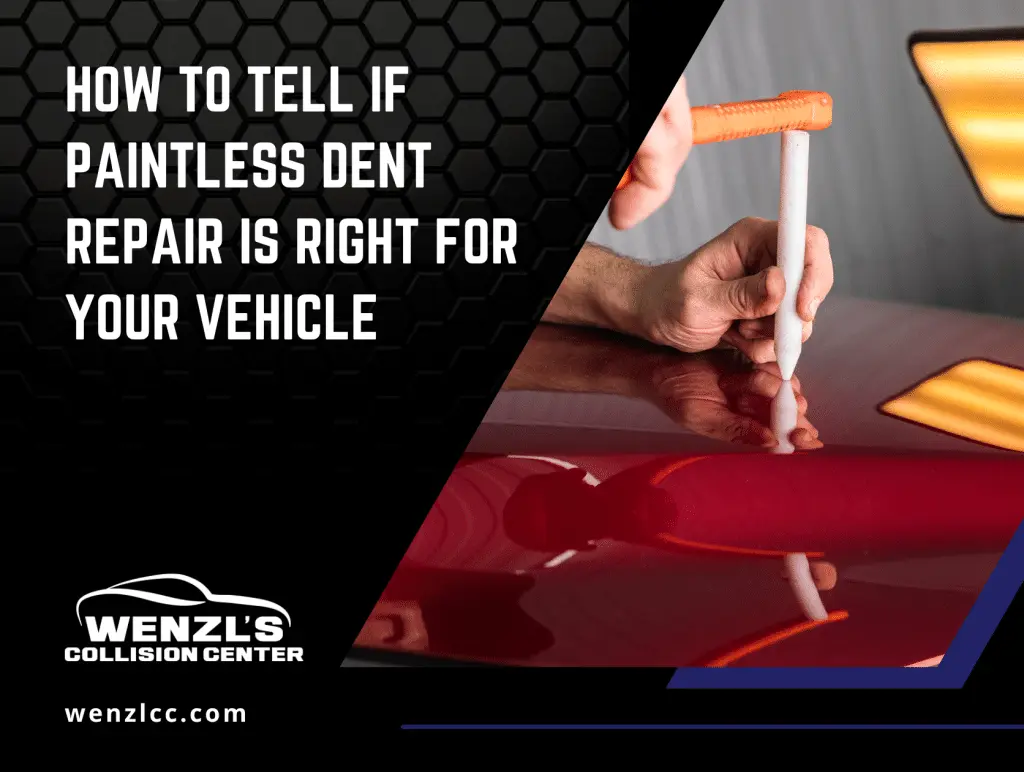
Paintless Dent Repair is a specialized repair method that removes dents without sanding, filling, or repainting the damaged panel.
Using specialized tools, technicians carefully reshape the metal from behind the panel whenever possible while preserving the factory finish.
PDR is commonly used for:
- Door dings
- Hail damage
- Minor dents
- Small creases
- Certain low-speed impacts
According to Wikipedia’s overview of Paintless Dent Repair, the process is most effective when the vehicle’s paint remains intact, and the metal has not been excessively stretched.
The Condition of the Paint Is One of the Biggest Factors
One of the first things technicians evaluate is whether the paint has been damaged.
Paintless Dent Repair is often possible when:
- Paint remains intact
- Clear coat is undamaged
- No cracks are present
- No exposed metal exists
If the paint has chipped, cracked, or peeled, traditional auto body repair may be the better solution because refinishing is often necessary to restore the vehicle’s appearance and protect against corrosion.
The condition of the paint is critical because Paintless Dent Repair is specifically designed to preserve the vehicle’s original factory finish. If the paint remains flexible and undamaged, technicians can often reshape the metal from behind the panel without affecting the exterior coating.
This allows the dent to be removed while maintaining the original paint, which is typically more durable and consistent than any refinished surface. Preserving the factory finish also eliminates the need for color matching, blending, or repainting, helping maintain the vehicle’s original appearance.
When the paint has been compromised, however, the repair process changes. Cracked, chipped, or peeling paint leaves the underlying metal vulnerable to moisture, road salt, and other environmental contaminants that can lead to corrosion over time.
Even if the dent itself could technically be reshaped, attempting Paintless Dent Repair on a damaged finish may cause the paint to crack further or separate from the panel. In these situations, conventional auto body repair and refinishing provide a more complete solution by restoring both the damaged metal and the protective paint system.
For drivers in Lincoln, NE, determining whether the paint is suitable for Paintless Dent Repair requires a professional inspection. Wenzl’s Collision Center carefully evaluates the condition of both the dent and the surrounding finish before recommending a repair method.
By considering the paint, panel condition, and overall extent of the damage, the team helps ensure every customer receives the repair solution that best restores the vehicle’s appearance, protects it from future corrosion, and delivers long-lasting results.
Dent Size and Depth Matter
Every dent is unique.
Technicians evaluate factors such as:
- Dent diameter
- Dent depth
- Sharpness
- Metal stretching
- Overall panel condition
A larger, shallow dent may be more suitable for PDR than a small dent with a sharp crease that has permanently stretched the metal.
Location Plays an Important Role
The location of the dent can affect whether specialized tools can reach the damaged area.
Technicians consider:
- Panel accessibility
- Reinforcement structures
- Body lines
- Panel edges
- Curved surfaces
Some dents located near the edge of a panel or behind reinforced sections may require traditional repair methods instead of Paintless Dent Repair.
The position of a dent on the vehicle often has a significant impact on whether Paintless Dent Repair is a practical solution. For PDR to be successful, technicians typically need access to the back side of the damaged panel so they can carefully manipulate the metal using specialized tools.
If braces, support structures, or other vehicle components block access to the dent, the repair may become more challenging or require an alternative approach. In some cases, technicians may be able to access the area by removing interior trim panels or other components, but every vehicle presents unique design considerations.
Body lines and panel contours also influence the repair process. Dents located on sharp body lines, near panel edges, or along complex curves can be more difficult to restore because these areas are engineered with specific shapes that contribute to both appearance and structural strength.
Repairing dents in these locations requires exceptional precision to return the panel to its original form without affecting the surrounding surface. Even a relatively small dent may require conventional repair methods if its location prevents technicians from achieving the desired result through Paintless Dent Repair alone.
For drivers in Lincoln, NE, a professional evaluation is the best way to determine whether a dent’s location makes it a suitable candidate for PDR. Wenzl’s Collision Center carefully inspects the position of every dent, along with panel accessibility and overall damage, before recommending the most appropriate repair solution. This detailed assessment helps ensure each vehicle receives a repair method that restores both its appearance and long-term durability.
Hail Damage Is Often a Good Candidate
Many hail-damaged vehicles qualify for Paintless Dent Repair because the dents are typically small and do not break the paint.
PDR may help repair:
- Roof dents
- Hood dents
- Trunk dents
- Fender dents
Drivers requiring professional Paintless Dent Repair often find that early inspections improve the chances of preserving the factory finish before additional damage occurs.
According to the National Weather Service, hailstorms can produce vehicle damage ranging from minor cosmetic dents to more significant impacts depending on hail size and storm intensity.
Why Preserving Factory Paint Matters
Factory paint is applied under carefully controlled manufacturing conditions.
Preserving the original finish helps:
- Maintain appearance
- Protect against corrosion
- Improve color consistency
- Reduce repair time
- Preserve long-term durability
Whenever Paintless Dent Repair is appropriate, keeping the factory finish intact can be one of the biggest advantages of the repair process.
Every Vehicle Should Be Professionally Inspected
Not every dent can be evaluated by appearance alone.
Professional inspections may include:
- Visual assessment
- Paint inspection
- Panel evaluation
- Hidden damage assessment
- Accessibility review
- Repair feasibility
Drivers seeking professional Auto Body Repair benefit from repair facilities that evaluate every vehicle individually before recommending a repair method.
According to I-CAR, proper repair planning and vehicle inspection are essential for complete and quality collision repairs.
When Traditional Auto Body Repair May Be Better
Although Paintless Dent Repair offers many advantages, it is not appropriate for every type of damage.
Traditional repairs may be recommended when:
- Paint has been damaged.
- Metal has stretched significantly.
- Sharp creases are present.
- Structural damage exists.
- Panels require replacement.
A professional inspection helps determine which repair method will provide the safest and most durable result.
Choosing the Right Repair Facility
Before scheduling repairs, consider asking:
- Does the dent qualify for Paintless Dent Repair?
- How is the damage evaluated?
- Will the factory paint be preserved?
- What repair method do you recommend?
- How is repair quality verified?
These questions help you understand the repair process before work begins.
According to Consumer Reports, consumers should evaluate repair quality, technician experience, and communication when selecting a collision repair facility.
Frequently Asked Questions
1. Can every dent be repaired with Paintless Dent Repair?
No. The size, location, paint condition, and amount of metal stretching determine whether PDR is appropriate.
2. Does PDR require repainting?
No. One of the primary advantages of Paintless Dent Repair is that it preserves the original factory finish.
3. Is hail damage a good candidate for PDR?
Many hail dents qualify if the paint remains intact and the metal has not been significantly stretched.
4. Why is the paint condition so important?
If the paint is cracked or chipped, refinishing may be required even if the dent itself could be reshaped.
5. How long does Paintless Dent Repair take?
Repair time varies depending on the number, size, and location of the dents.
6. Can deep dents still qualify for PDR?
Some can, but deeper dents or those with sharp creases may require traditional auto body repairs.
7. Why should I have a professional inspection?
Technicians can evaluate hidden factors that determine whether Paintless Dent Repair is the most appropriate solution.
8. Why choose Wenzl’s Collision Center?
Wenzl’s Collision Center provides professional Paintless Dent Repair, comprehensive inspections, experienced technicians, and customer-focused service to help drivers throughout Lincoln, NE restore their vehicles with confidence.
Conclusion
Paintless Dent Repair offers an efficient and effective solution for many types of minor vehicle damage, but it is not the right repair method for every dent. Factors such as paint condition, dent depth, panel location, and metal stretching all influence whether PDR can successfully restore the damaged area. A professional inspection is the best way to determine the most appropriate repair method while preserving your vehicle’s appearance and long-term value.
If your vehicle has suffered dents from hail, parking lot incidents, or everyday driving in Lincoln, NE, Wenzl’s Collision Center is here to help. Visit 4515 N 62nd St, Lincoln, NE 68507, United States, to request an appointment, schedule a professional dent inspection, or learn whether Paintless Dent Repair is the right solution for your vehicle.
